
We’ve made two visits to Hearst Castle, the first in 2011 and the second on a later trip, touring the hilltop mansion that newspaper magnate William Randolph Hearst built above the tiny town of San Simeon on California’s Central Coast, about halfway between Los Angeles and San Francisco.
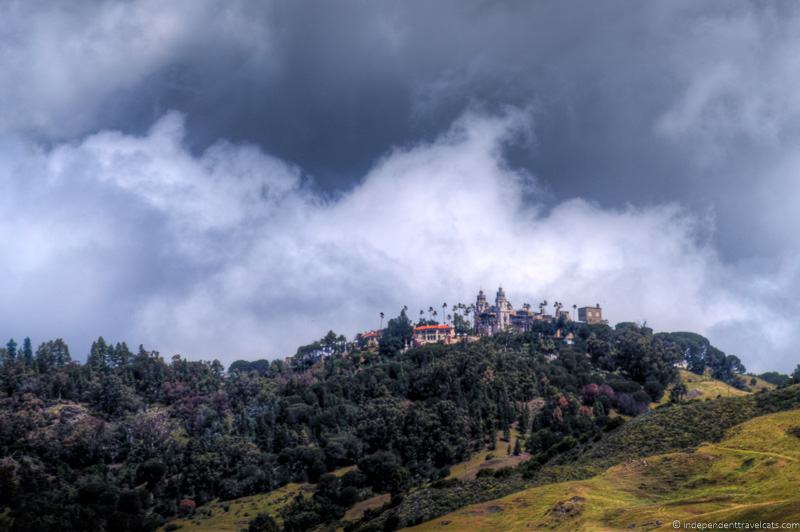
Hearst, with the help of San Francisco architect Julia Morgan, began construction of his dream mansion in 1919, a project that would continue for the next 30 years. Hearst named the property “La Cuesta Encantada,” Spanish for “The Enchanted Hill.”
The architecturally eclectic property, now known as Hearst Castle, had a private airfield, two giant swimming pools, a movie theater, tennis courts, over 100 acres of gardens, two greenhouses, and one of the world’s largest private zoos. It was once open only by invitation to A-list celebrities and politicians, such as Clark Gable, Joan Crawford, Charlie Chaplin, and Winston Churchill.
Today Hearst Castle is a historical landmark offering tours to the public. This guide covers how to visit, how to buy tickets, which tour to choose, tips for making the most of your visit, and the best things to do near Hearst Castle.
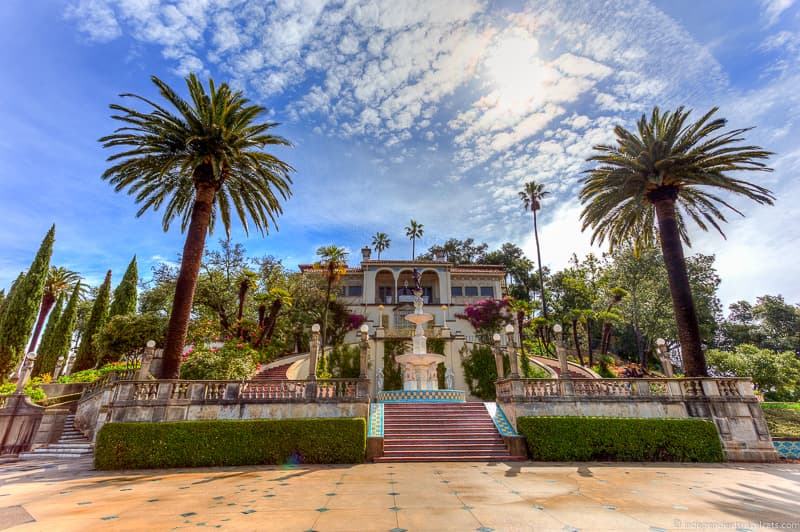
Table of Contents:
Is Hearst Castle Worth Visiting?
Yes. After two visits, we’d call Hearst Castle one of the most rewarding stops on California’s Central Coast, and well worth building into a Pacific Coast Highway road trip. There isn’t anywhere else in the United States quite like it: a hilltop estate of 165 rooms, two giant pools, and one of the largest private art collections in the country, all open to the public for the price of a guided tour.
For most first-time visitors, the Grand Rooms Tour is the one to book. It covers the grand public rooms of Casa Grande and works as the ideal introduction, and at about 70 minutes it leaves you time to add a second tour or wander the gardens and pools afterwards. If you’ve been before, the Upstairs Suites or Cottages & Kitchen tours show you parts of the estate the Grand Rooms Tour skips, and the seasonal evening tours, with volunteers in 1930s dress, are worth planning a trip around.
Tickets for the standard daytime tours are $35 per adult and $18 per child aged 5 to 12, booked through ReserveCalifornia. Plan on at least two to three hours once you factor in the bus ride up the hill, the film, and time in the gardens. And if you can, avoid the midday rush: an early-morning tour is cooler and quieter, while late afternoon gives you the best light over the Pacific.
Hearst Castle Tours at a Glance
There are several tours to choose from, each covering a different part of the estate. Here’s how they compare.
| Tour | Length | Price (adult / child) | What you see | Best for |
|---|---|---|---|---|
| Grand Rooms Tour | 70 min | $35 / $18 | Casa Grande’s main public rooms: Assembly Room, Refectory, Billiard Room, and theater | First-time visitors |
| Upstairs Suites Tour | 70 min | $35 / $18 | Upper floors of Casa Grande: library, guest suites, Hearst’s private suite and study | A strong second tour |
| Cottages & Kitchen Tour | 70 min | $35 / $18 | Two guest cottages, the Casa Grande kitchen, and the wine cellar | Repeat visitors |
| Designing the Dream Tour | 75 min | $40 / $23 | Casa del Sol, the North Wing of Casa Grande, and the Hearst and Morgan story | Architecture and design fans |
| Julia Morgan Tour | 120 min | $110 per person | A longer, semi-private deep dive into the estate and Morgan’s work (seasonal, not offered in summer) | Serious enthusiasts |
| Evening Tour | ~100 min, seasonal | See current rates | Grand Rooms and Upstairs highlights after dark, with volunteers in 1930s dress | A special first or second visit |
Every daytime tour includes the bus ride to the hilltop, the 40-minute Hearst Castle: Building the Dream film, a stop at both the Neptune and Roman pools, and time to explore the gardens.
Brief History of Hearst Castle
The history of Hearst Ranch begins with William Randolph Hearst’s father, George Hearst. George Hearst was born in Missouri in 1820 on a small farm, eventually heading west to California as part of a small wagon train crossing the California Trail in 1850 during the Gold Rush. Hearst was one of the lucky ones, striking it rich and eventually becoming a wealthy businessman and politician.
In 1865, George Hearst purchased 48,000 acres of the Piedra Blanca Rancho from José de Jesus Pico. Over time, he would buy more land in the area, and by 1886 the Hearst Ranch had grown to 270,000 acres. The land was used primarily for ranching and stud farming.
George Hearst did build an 18-room Victorian ranch house in 1878 on the property, which is still standing today and still used by the Hearst family. But he left most of the property undeveloped, and it would stay this way until it was later inherited by his only child, William Randolph Hearst.
William Randolph Hearst & His Dream
William Randolph Hearst became well-known for his participation in politics, use of yellow journalism, extensive artwork collection, and his long-term affair with actress Marion Davies. But he is perhaps best remembered for his former home, Hearst Castle.
As a child, William Randolph Hearst enjoyed camping holidays with his parents on Hearst Ranch, favoring an area they called Camp Hill. Hearst saw very little of his busy father as a child, which likely made these summer camping holidays very memorable.
Because of George Hearst’s great wealth, he was able to send his wife and son on grand tours of Europe. Young William first visited Europe with his mother at the age of 10. This trip, and subsequent trips to Europe, made a great impression on him. He was fascinated with the history, the architecture, the castles, and the art in Europe. As an adult he became an avid collector of art, furniture, and antiquities from Europe.
Although William had great advantages from his father and family wealth, he went on to build a media empire of his own which still exists today. After Hearst married and had his own children, he and his wife Millicent and their children often visited San Simeon to go camping on Camp Hill.
After his mother’s death in 1919, William Randolph Hearst commissioned architect Julia Morgan, whom he had already worked with on prior Hearst projects, to build him a house on what was then known as Camp Hill. At first, he just wanted a modest bungalow so that his family and friends would not have to sleep out in the open on camping trips.
Hearst’s initial ideas became grander and grander over time. Hearst and Morgan started their project in 1919 and construction would continue on the hill until 1947. Camp Hill would be transformed into La Cuesta Encantada, and Hearst would have his very own “castle” filled to the brim with his massive collection of art and furniture.
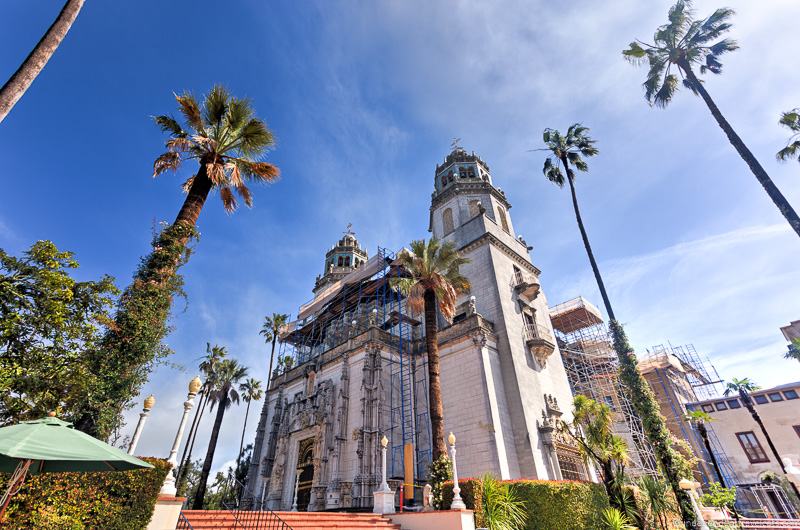
In the end, Hearst and Morgan would construct one giant house (Casa Grande) and 3 bungalows of varying sizes (Casa del Sol, Casa del Mar, and Casa del Monte). There are a total of 165 rooms across these four buildings.
There would also be 2 giant swimming pools, a tennis court, a wine cellar, a private zoo, a private theater, an airfield, greenhouses, and elaborate landscaped gardens. That’s not counting the many ranch buildings elsewhere on the large ranch, which included barns, warehouses, and homes for the ranch employees.
The planned work on Hearst Castle was never actually completed, as it was ongoing until Hearst’s health began to decline and he had to leave the hilltop. Some parts of Casa Grande, for instance, were left unfinished and undecorated, and plans for a large ballroom and more guesthouses were never begun.
Hearst had his American castle, although he referred to it simply as “the ranch.” In 1919, he stated: “I would rather spend a month at the ranch than any place in the world.”
Hearst Castle as a Hollywood Party Spot
Hearst Castle was initially intended as a family home, but by 1926 he and his wife had separated (although never divorced) and he was living openly with his mistress Marion Davies. Hearst spent most of his time in California in either San Simeon or Los Angeles, while Millicent stayed in New York. She rarely visited the house after 1926.
William Randolph Hearst owned the largest media conglomerate in the world, which included a number of newspapers, magazines, radio stations, and even a film company. He was also very involved in politics, even unsuccessfully running for President of the United States in 1904. This meant he had connections that ranged from actors and writers to senators and presidents.
From the late 1920s to the 1940s, Hearst and Marion Davies would regularly entertain a stream of the rich, famous, and powerful. Hearst Castle became a popular and coveted getaway for Hollywood celebrities who could enjoy first-rate amenities at an isolated spot far from the paparazzi.
Visitors over the years included Clark Gable, Sir Winston Churchill, Howard Hughes, Joan Crawford, Greta Garbo, Cary Grant, George Bernard Shaw, Jack Warner, Calvin Coolidge, Charlie Chaplin, and Louis B. Mayer. While his guests enjoyed the amenities, Hearst would spend most of his days in his office running his businesses, then join his guests in the evenings for dinner and entertainment.
P.G. Wodehouse, an English humorist, was a guest at Hearst Castle along with his wife Ethel and dog Winks in 1931. They stayed in the Venetian suite and he wrote the following in a letter to his friend William Townend on February 25, 1931:
“The house is enormous, and there are always about fifty guests staying there. All the furniture is period, and you probably sleep on a bed originally occupied by Napoleon or somebody.”
Future British Prime Minister Winston Churchill and his son were guests of Hearst and his wife in 1929, staying at Hearst Castle (in Casa del Mar) for 4 days, as well as being Hearst’s guest in Los Angeles. Churchill wrote the following in a letter to his wife Clementine on September 29, 1929:
“Hearst was most interesting to meet, & I got to like him – a grave simple child – with no doubt a nasty temper – playing with the most costly toys. A vast income always overspent: ceaseless building & collecting not very discriminatingly works of art: two magnificent establishments, two charming wives [he met both Millicent and Marion Davies]; complete indifference to public opinion, a strong liberal & democratic outlook, a 15 million daily circulation, oriental hospitalities, extreme personal courtesy (to us at any rate) & the appearance of a Quaker elder – or perhaps better Mormon elder.”
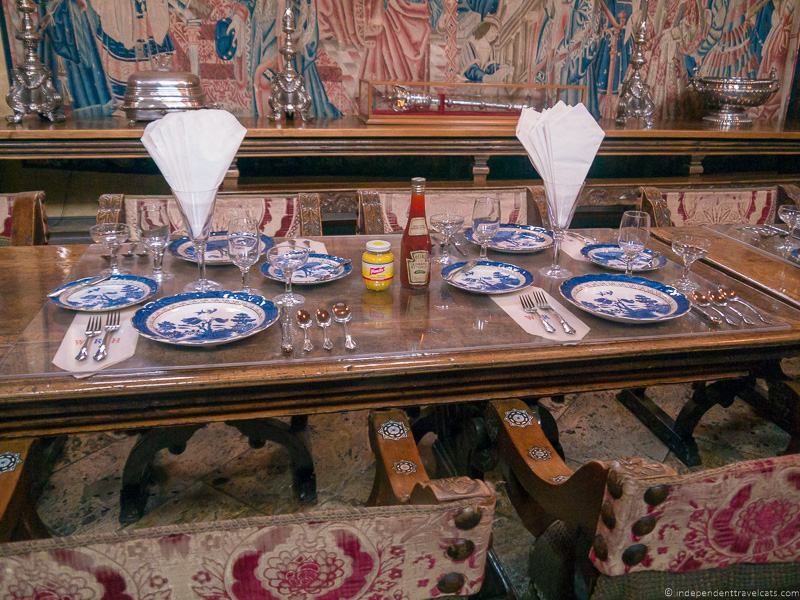
Despite the glitzy house and elaborate parties, Hearst still tried to maintain the ranch atmosphere that he had always loved. He took guests horseback riding and on overnight camping trips (much to some visitors’ discomfort) and had the grand dining table set with paper napkins and ketchup bottles.
In 1941, Hearst and Hearst Castle also became the partial inspiration for the film Citizen Kane by Orson Welles. In the film, Hearst Castle is the model for Xanadu, the home of Charles Foster Kane. The film enraged Hearst, especially in its poor depiction of his mistress, and he tried unsuccessfully to have it banned and suppressed.
Hearst Castle as a Tourist Attraction
Hearst left his beloved home for the last time in 1947 because of deteriorating health. He died in 1951 in Beverly Hills. He wanted to donate La Cuesta Encantada to the University of California, but they did not accept the gift as they felt they would be unable to manage such a large undertaking.
In 1957, the Hearst Corporation and the Hearst family donated the hilltop and its buildings to the State of California. In 1958, the State of California opened Hearst Castle to the public as the Hearst San Simeon State Historical Monument. The first regular public tours began in June 1958.
Today there are several different tours offered at Hearst Castle, along with a large Visitor Center and theater. Over the years, Hearst Castle has become the most visited paid attraction in Central California. It draws around 750,000 visitors a year.
Although the Hearst family donated Hearst Castle, the Hearst Corporation still owns Hearst Ranch in San Simeon, which includes over 80,000 acres of land and is one of the largest working cattle ranches in Central California. The Hearst family remains active in the management of the land around the castle, and some family members still visit and even stay overnight occasionally (usually in the original Victorian ranch house, which is not open to the public).
I am not sure what Hearst would make of the hundreds of thousands of uninvited visitors wandering around his home, but it is pretty amazing that Hearst Castle still draws so many people fascinated with his dream home.
Planning Your Visit to Hearst Castle
Here is everything you’ll need to plan your visit to Hearst Castle and the surrounding area, including how to get there, which tours are offered, how to book, the best time to go, and what to do nearby.
Where is Hearst Castle located?
Hearst Castle is located along California’s Central Coast in the small town of San Simeon, near the town of Cambria. It is about halfway between Los Angeles and San Francisco.
Address: 750 Hearst Castle Road, San Simeon, CA 93452
How do you get to Hearst Castle?
Hearst Castle is most easily reached by car. If you’re visiting California, it makes a great stop on a Pacific Coast Highway road trip. You can also get there by public transit, day tour, or taxi.
By car
Hearst Castle is about a 1-hour drive from San Luis Obispo, a 3.5 to 4-hour drive (240 miles) from San Francisco, and a 4-hour drive (230 miles) from Los Angeles. There is free visitor parking at the Visitor Center.
By public transit
You can reach Hearst Castle by bus, or a mix of bus and train, though it takes some planning. SLO RTA Route 15 runs along the coast between Morro Bay, Cayucos, Cambria, and San Simeon, with a stop right by the Visitor Center (about a one-minute walk). Note that the Hearst Castle Visitor Center stop is served on Saturdays and Sundays only; on weekdays Route 15 runs the corridor but does not stop at the Castle itself. Check current schedules and fares on the SLO RTA website.
If you’re coming from further away, such as San Francisco, Sacramento, or Los Angeles, you’ll likely connect via Greyhound or Amtrak to a hub like San Luis Obispo or Paso Robles, then pick up the local bus network.
By day tour
If you’d rather not drive or rely on the bus, you can join a day tour that includes Hearst Castle. Most run from San Francisco or other Central Coast towns. We list the current options in the day tours section below.
By plane
The nearest airport to Hearst Castle is San Luis Obispo County Regional Airport, about a 1-hour drive away. From San Luis Obispo, you can rent a car, take the public bus, book a day tour, or arrange a taxi or shuttle to Hearst Castle.
What is there to do at Hearst Castle?
The two main things to do at Hearst Castle are visiting the Visitor Center and taking a tour up to the hilltop.
- Stop at the Visitor Center (free), which includes a small exhibit area about William Randolph Hearst and Hearst Castle, a casual restaurant, a cafe, and a gift shop.
- Watch the 40-minute film Hearst Castle: Building the Dream (included with daytime tour tickets) at the Visitor Center.
- Take one of the several tours offered at Hearst Castle. Each explores different parts of the estate’s buildings, and all include a bus ride to the top of the hill, a visit to the interiors of Hearst Castle, the two pools, and the gardens. Tours run in the daytime as well as in the evenings during certain times of the year.
- After your tour ends, you can explore the gardens further on your own.
How much does it cost to visit Hearst Castle?
Tickets for the standard daytime tours, including the most popular Grand Rooms Tour, are $35 per adult and $18 per child aged 5 to 12. Children under 5 are generally free. The longer Designing the Dream Tour is $40 per adult and $23 per child, and the seasonal, semi-private Julia Morgan Tour is $110 per person. You can compare all of the tours in the table near the top of this guide.
A small service fee applies when you reserve tickets in advance online or by phone.
What tours are offered at Hearst Castle?
You must join a guided tour to see inside Hearst Castle, and there are several to choose from. Every daytime tour includes the bus ride to the hilltop, a stop at both the Neptune Pool and the Roman Pool, and time to explore the gardens afterwards. The table near the top of this guide compares them at a glance, and here is a little more on each.
The Grand Rooms Tour is the 70-minute introductory tour and the one we recommend for most first-time visitors. It covers the grand public rooms of Casa Grande: the Assembly Room, the Refectory, the Billiard Room, and the private theater. The Upstairs Suites Tour, also 70 minutes, heads to the upper floors of Casa Grande, including the library, the guest suites, and Hearst’s private suite and study, and it makes a good second tour.
The Cottages & Kitchen Tour (70 minutes) takes you into two of the guest cottages, the Casa Grande kitchen, and the wine cellar. The Designing the Dream Tour (75 minutes) focuses on how the estate was built and the long collaboration between Hearst and Julia Morgan, visiting Casa del Sol and the North Wing of Casa Grande. It’s the one to pick if you care about architecture or interior design.
For a deeper visit, the Julia Morgan Tour is a longer, semi-private two-hour tour devoted to Morgan’s work. It runs seasonally and is not offered in summer. The seasonal evening tours, offered in spring and fall, let you see Casa Grande after dark, illuminated and staffed by volunteers in 1930s dress, covering most of the rooms from the Grand Rooms and Upstairs Suites tours.
There are also stair-free ADA accessible versions of several tours, along with special-interest, holiday, and private options. Check the official website for current availability.
How do you buy tickets for Hearst Castle?
Tickets are booked through ReserveCalifornia, the California State Parks booking system, either online or by phone (U.S.: 1-800-444-4445, International: 1-833-448-7287). You can also buy them in person at the Visitor Center ticket office. Tickets are released up to 60 days before your visit date.
A service fee applies to tickets booked in advance, so buying in person saves a little. But tours often sell out in busy months, so if you need a particular date or time, book ahead. You can check the booking calendar for availability before you go.
If you book in advance, note that changes and cancellations are allowed up to one hour before your tour, but they carry a non-refundable registration fee per ticket. Don’t lock in a date until you’re sure of it.
Private and group tours can also be arranged. Contact Hearst Castle directly for the current options and pricing.
Can you do more than one tour in the same day?
Yes. You just need a separate ticket for each tour. A common combination is the Grand Rooms Tour plus one of the more in-depth tours, so you see both the main public rooms and another part of the estate.
If you plan to do two tours in a day, book them with at least two hours between start times. That gives you enough of a gap for the bus ride up and down and a little breathing room in between. When you collect your wristbands, ask the staff exactly where and when to meet for your second tour.
Is food available at Hearst Castle?
Yes. Meals are available at the Chief’s Galley Cafe in the Visitor Center, which serves sandwiches, soups, grilled items, salads, and more. You can try the local grass-fed Hearst Ranch beef here.
For a lighter meal or snack, stop at La Cuesta Coffee Shop, which serves coffee, tea, sandwiches, and snacks. In the summer months, an outdoor BBQ spot is also usually open in the Visitor Center courtyard.
Note that you cannot bring food or drinks (except bottled water) on the tours or to the hilltop, and there is no food for sale on the hilltop.
What other services are at Hearst Castle?
The Visitor Center includes ticket booths, a casual restaurant, a coffee shop, restrooms, an exhibition area, and a book and gift shop. Free parking is located next to the Visitor Center.
The Hearst Castle Theater in the Visitor Center shows the 40-minute film Hearst Castle: Building the Dream several times a day. The film is included with the price of all daytime tours, and it can be added to most evening tours for an additional fee.
Is Hearst Castle wheelchair accessible?
Hearst Castle is partially wheelchair accessible. The regular tours require participants to walk up and down some stairs. However, there are stair-free ADA accessible tours (both day and evening) designed for wheelchair users and those with limited mobility or who can’t stand for long periods.
The accessible tours run year-round and cover sections of the gardens, the two pools, and the ground-floor highlights of Casa Grande or the cottages, depending on the route. Current accessible offerings include the Grand Rooms Accessible (ADA), Art Under the Moonlight Accessible (ADA), and Holiday Twilight Accessible (ADA) tours. Reserve in advance to guarantee a space.
The Visitor Center is wheelchair accessible, with accessible restrooms. Wheelchairs up to 28 inches wide can be accommodated at the Castle, and wheelchairs are available to borrow at no additional charge.
Is photography allowed at Hearst Castle?
Yes. Personal photography is allowed inside the buildings and in the gardens. Flash photography is permitted outside only, not inside the houses. Tripods are not allowed on the tours, though monopods are permitted.
For commercial photography or filming, you’ll need a permit and prior approval, so contact Hearst Castle in advance.
Are dogs allowed at Hearst Castle?
No. Pets are not allowed on the tours or anywhere on the hilltop estate, and the only animals permitted are service animals. There is no kennel or pet boarding at the Visitor Center, so you’ll need to make other arrangements for your dog on the day you tour the Castle.
The good news is that the wider San Simeon area is fairly dog-friendly. Leashed dogs are welcome in some nearby spots, including parts of W.R. Hearst Memorial State Beach across from the Visitor Center and the Moonstone Beach boardwalk in Cambria, so your dog can still enjoy the coast while you tour the hilltop.
How long do you need at Hearst Castle?
Plan on at least 2 hours at Hearst Castle, though we’d allow 3 hours to see everything without rushing. You can easily spend 4 hours or more.
Most of the daytime guided tours run about 70 to 75 minutes, with the seasonal tours longer. Add in the 40-minute film at the Visitor Center, the bus ride up and down the hill, free time in the gardens, and a stop at the exhibition and gift shop, and you can easily fill a morning or afternoon. Add more time if you plan to eat here or take a second tour.
If you’re short on time, in 2 hours you can collect your ticket, watch the film, do the guided tour, and head straight back down to the Visitor Center. Check the film and tour timings and plan accordingly.
Even with a pre-booked ticket, we recommend arriving at the Visitor Center at least 15 to 20 minutes before your tour to collect your wristbands and get on the bus in time.
Can you take a day tour to Hearst Castle?
If you’re staying in San Francisco or along the Central Coast, you can join a day tour that visits Hearst Castle. Here are two we’d point you to:
- This private day tour from San Francisco pairs Hearst Castle with Big Sur, Carmel, and the 17-Mile Drive.
- This private full-day tour from San Francisco includes the Grand Rooms tour at Hearst Castle plus stops in Santa Barbara and Solvang, with a guide and air-conditioned transport.
If you’re based in Los Angeles, there aren’t any reliable single-day tours that reach Hearst Castle and return the same day, so a multi-day trip is the better option from there. This 3-day private tour from Los Angeles takes in Hearst Castle and Big Sur along the Pacific Coast, a more relaxed way to see them than a long round trip in a day.
Tour itineraries can change, so read the full, current description before booking to confirm it includes a visit to Hearst Castle.
What’s the best time to visit Hearst Castle?
Hearst Castle is open daily year-round and is typically closed only on a few major holidays, so you can visit at almost any time of year. Check the current calendar before you book, since holiday closures can change.
Summer and the holiday periods are the busiest and hottest times, so we’d avoid them if you want thinner crowds. Winter is the quietest, especially outside the holidays, though the gardens are past their best and the exposed hilltop is at its coolest. Spring and fall are the sweet spot for us: mild weather, good light, and fewer people.
Time of day matters as much as the season. Midday tours are the busiest and warmest, so if you can, book an early-morning slot, when the hilltop is cooler and quieter, or a late-afternoon one, when the light over the Pacific is best for photos. The evening tours run only in spring and fall, so plan around those if you want to see Casa Grande lit up at night.
What else is there to do near Hearst Castle?
Hearst Castle works best as part of a Central Coast road trip rather than a stop on its own. Most people fold it into a Pacific Coast Highway drive, pairing the morning tour with the towns and coastline around San Simeon and Cambria. A natural route runs from the elephant seal rookery at Piedras Blancas, south past the Castle to Moonstone Beach and the wineries around Cambria. For a fuller list, see our guide to things to do in Cambria. Here are some ideas to get you started:
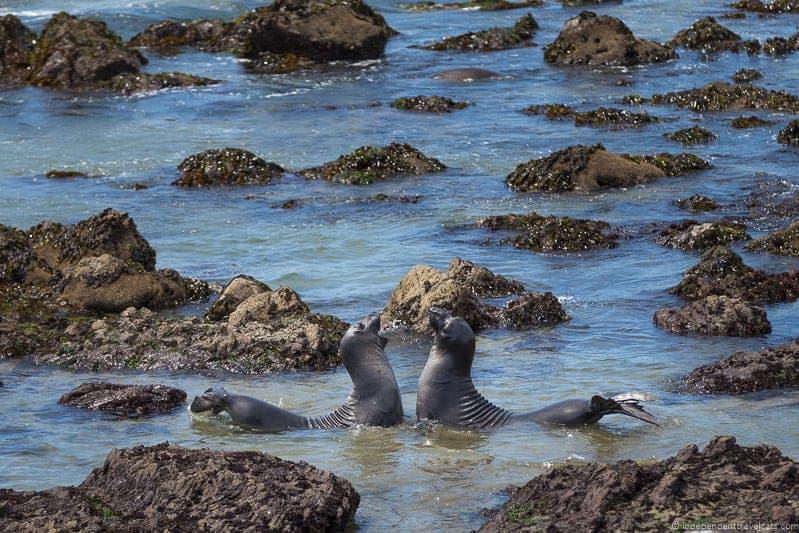
- At the elephant seal viewing area at Piedras Blancas, a few miles north of the Castle on Highway 1, you can usually see elephant seals hauled out on the beach below, sometimes a handful and sometimes thousands. They’re present year-round, with the breeding peak from December through March and most pups born in January. It’s free, open sunrise to sunset, and there’s a boardwalk. You can learn more from the Friends of the Elephant Seal, and the area is part of the Monterey Bay National Marine Sanctuary, with more to see at the Coastal Discovery Center in San Simeon.
- The Piedras Blancas Light Station first lit in 1875, with a fog signal building added in 1905. Guided tours of the lighthouse and the history of its keepers run on select days.
- For wine, Hearst Ranch has its own winery with an oceanfront tasting room in San Simeon (open daily, reservations recommended), and there are more tasting rooms around Cambria, including Stolo Vineyards, now part of the Parr Collective. The Paso Robles wine region is a longer detour inland if you want a full day of tasting.
- There are several beaches nearby, including W.R. Hearst Memorial State Beach, Ragged Point, and Moonstone Beach in Cambria, which has a mile-long boardwalk along the bluffs.
- The Cambria Historical Museum covers local history in one of Cambria’s oldest buildings.
- Nitt Witt Ridge, a folk-art home built by an eccentric local out of found objects (including tiles salvaged from Hearst Castle), was sold in 2022 and no longer offers tours. You can still see the exterior from the street as a quirky drive-by.
- This stretch of Highway 1 is one of the finest drives in California, so leave time for the scenery along the Pacific Coast Highway.
For more ideas, see our Pacific Coast Highway road trip guide and our suggested 2 week California itinerary.
Where to stay near Hearst Castle?
If you want to stay overnight near Hearst Castle, we’d recommend looking in San Simeon (the town where Hearst Castle is located) or Cambria (the town just to the south). There are hotels, motels, apartments, and bed-and-breakfasts in both. This is a popular area, so expect higher-than-usual prices, especially in summer and around holidays.
- Quality Inn in San Simeon is a good-value 2-star motel with free continental breakfast, an outdoor heated pool, and a hot tub, about 4 miles from Hearst Castle.
- Cavalier Oceanfront Resort in San Simeon is a 3-star beachfront hotel with heated outdoor pools, a hot tub, and an on-site restaurant. Some rooms have fireplaces, patios, and ocean views. Family and dog friendly, about 4 miles from the Castle.
- El Colibri Hotel & Spa in Cambria is a 3-star boutique hotel with an on-site wine bar and spa; rooms include a deep soaking tub. It’s within walking distance of Moonstone Beach. We’ve stayed here and can recommend it, especially for couples. About 8 miles from the Castle.
- Cambria Shores Inn in Cambria sits across from the beach boardwalk, with continental breakfast and fireplaces in every room. Family and dog friendly, 8 miles from the Castle.
- J Patrick House Inn in Cambria is a bed-and-breakfast with a free wine hour, a cooked breakfast, and a shared lounge. Each room has a fireplace. Good for couples, 10 miles from the Castle.
- For budget travelers, the nearest hostel we know of is the San Luis Obispo Hostel, with dorm-style and private rooms and a shared kitchen, lounge, and laundry, about 42 miles (an hour’s drive) from the Castle.
For rooms and apartments, you can also check the local listings on Vrbo and other vacation rental websites.
Where can you find more information about Hearst Castle?
Hearst Castle is owned by California State Parks, and the official website is the best place for current tour times, prices, and bookings.
If you’d like to read more, there are a number of books about Hearst Castle, William Randolph Hearst, and architect Julia Morgan, which you can see here. One author worth seeking out is Victoria Kastner, the official Hearst Castle historian for over 20 years, who has written several.
You can also buy the film Hearst Castle: Building the Dream, shown in the Visitor Center theater, which tells the story of Hearst and the building of the estate. And if you’ve never seen Citizen Kane, watch it before or after your visit; Orson Welles’s film was loosely based on Hearst’s life, and the Castle was the model for the fictional Xanadu.
Our Visit to Hearst Castle
I have visited Hearst Castle twice, and since I went with two different people, we did the Grand Rooms Tour both times. This is the most popular tour and the one recommended for most first-time visitors, as it includes the grand public rooms on the main floor of Casa Grande, the largest house on the hilltop.
I first visited Hearst Castle in Spring 2011 and then a second time several years later. Both times, we reserved our tickets online and then brought our printed voucher to the ticket window to collect our tickets and wristbands.
We arrived about an hour before our tour and watched the 40-minute film Hearst Castle: Building the Dream, which gives a good overview of the construction of the castle and includes some vintage film clips from the 1920s and 1930s. We recommend watching it before your tour if you have time, but you can also watch it after.
There is also a free exhibition at the Visitor Center, and parts of it change over time with rotating collections. When we visited there was general information about William Randolph Hearst and Hearst Castle along with several objects on display.
The Bus Ride to the Hilltop
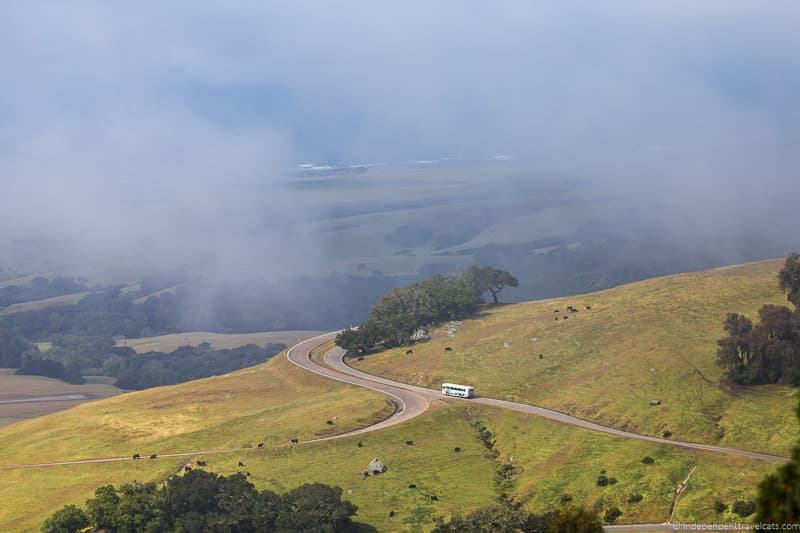
Then we got in line for the bus that drives you up the 5-mile route to the castle. The buses were clean and comfortable enough for the short ride, which takes about 10 minutes.
There are some nice views to enjoy from the window as you wind your way up the hilltop. You can also learn more about the property by listening to the recorded narration provided by the late Alex Trebek of Jeopardy about the property and grounds along the way.
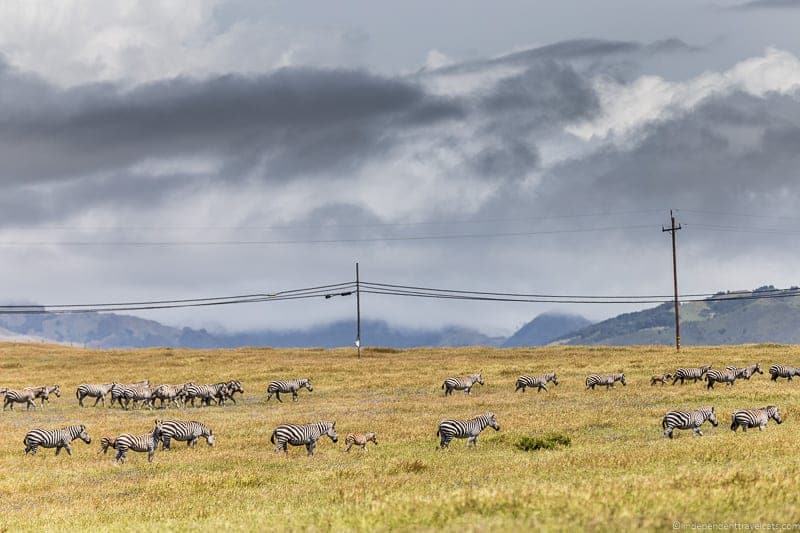
Keep a look out for zebra! William Randolph Hearst had one of the largest private zoos in the world in the 1930s, and a few free-roaming animals still remain, most notably a herd of zebra. You may get lucky and see them as we did, a bit odd to spot zebra along the California coast.
In the past, invited guests would arrive by private plane, train, or car. Upon entering the gated estate, they would commonly be driven past animals such as bison, camels, zebra, ostriches, and elk on their journey up to the house.
After the bus arrives at the hilltop, you’ll be sorted into the appropriate group based on the tour ticket you purchased. Then you’ll be introduced to your tour guide and given an introduction about the rules of the tours and the building of the property.
The Grand Rooms tours often have about 20 people per group, but the more specialized tours often have smaller groups.
The Hearst Castle Gardens
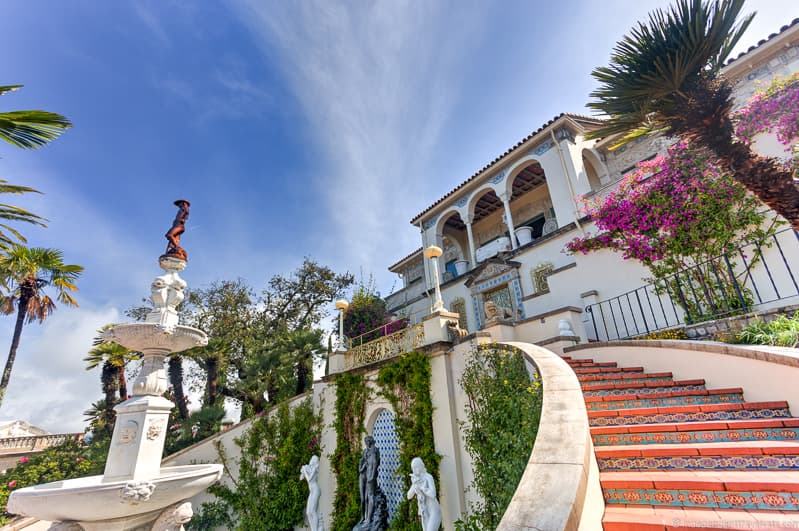
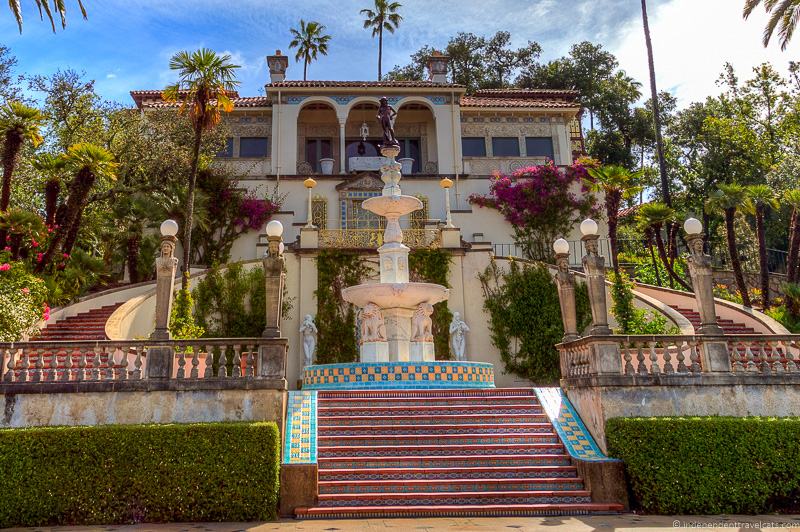
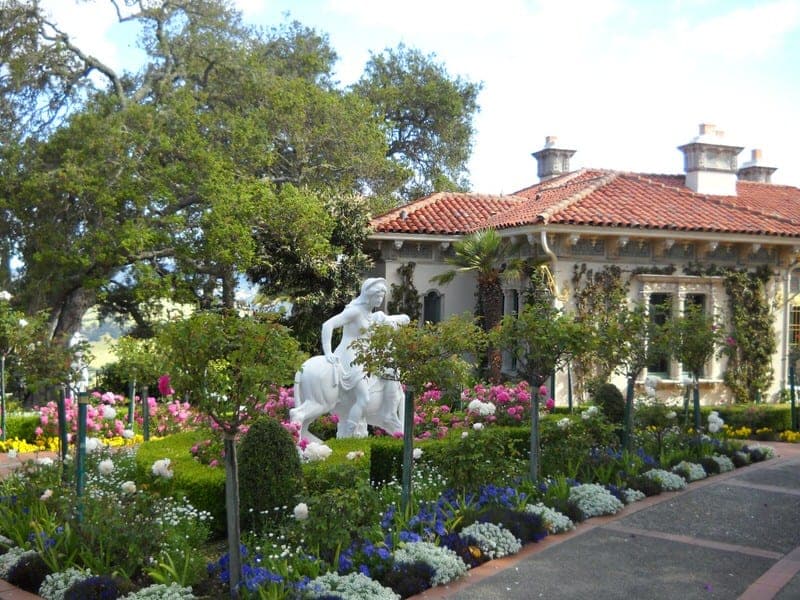
The first thing you’ll probably notice are the esplanade and gardens. I loved the scent from the orange trees on my first trip up to the hilltop.
Although Hearst Castle is best known for its buildings, particularly Casa Grande, the gardens were also planned in elaborate detail by Hearst and Julia Morgan and attended to by a large team of gardeners.
The gardens are mainly Mediterranean in influence, and you’ll see Spanish and Italian touches throughout the design. There are a wide variety of flowers, fruit trees, palm trees, and succulents here.
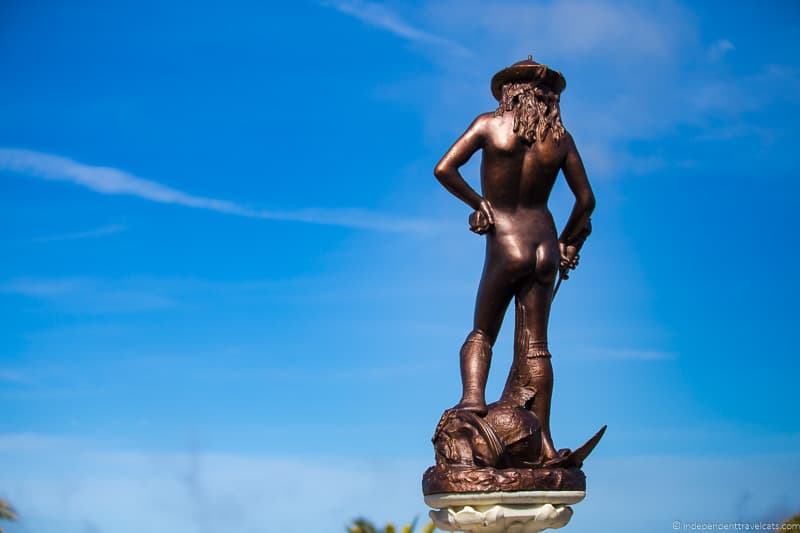
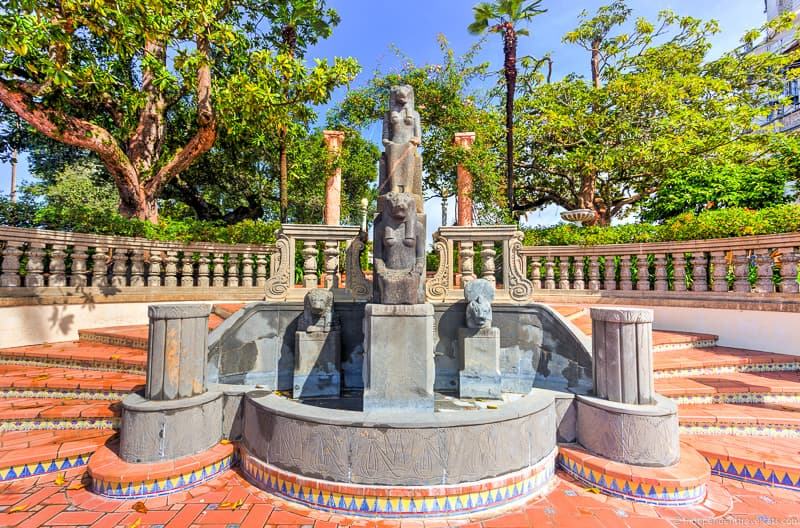
You’ll also find a number of fountains and statues throughout the gardens. This includes the oldest antiquity in Hearst’s collection, granite figures and heads of the Egyptian goddess Sekhmet dating to the 18th and 19th dynasties (approximately 1550 BC to 1189 BC).
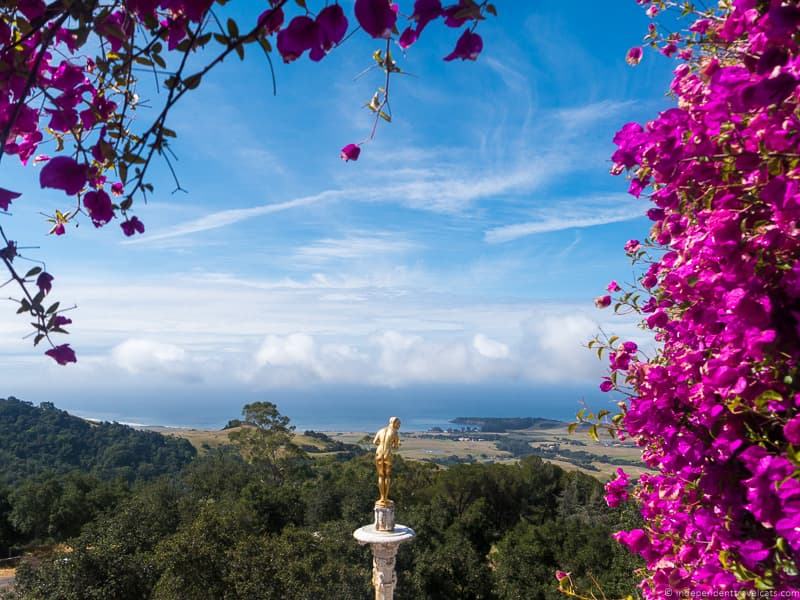
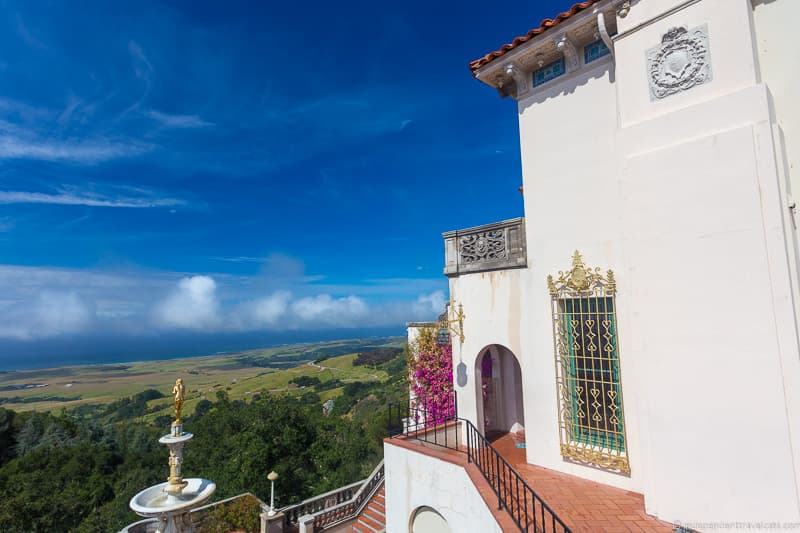
There are also some amazing views from the various terraces over the estate and the Central Coast. You can see all the way to the Pacific Ocean.
You’ll see only a few highlights on the tours, but afterwards you are welcome to explore the gardens on your own at your leisure. The gardens, terraces, and pools make up about 125 acres of the estate, so there is a large area to explore.
The Grand Rooms Tour at Hearst Castle
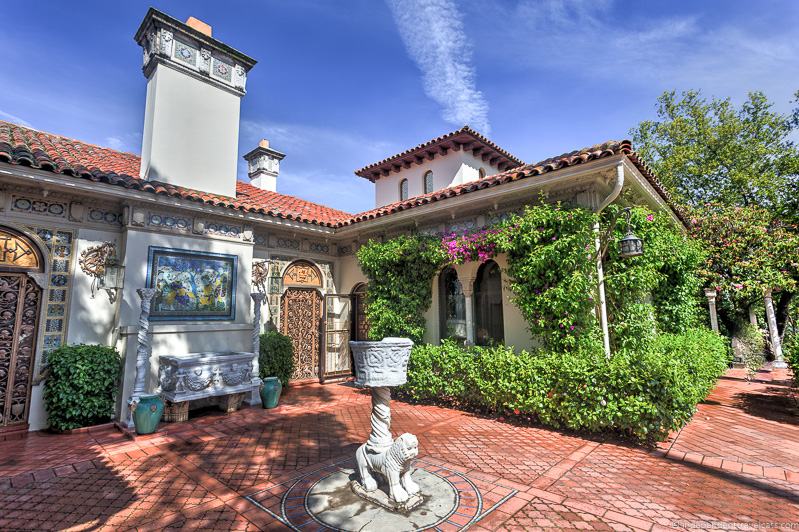
The exteriors of Casa Grande and the guest cottages have strong Spanish and Mediterranean influences, particularly Spanish Colonial Revival and Mediterranean Revival. But the interior designs and art collections inside Casa Grande are much more eclectic.
As you walk through the rooms, most are furnished and set up as they would have been during Hearst’s occupancy in the early twentieth century. You’ll learn that entire rooms (including the walls and floors) were sometimes taken from monasteries, churches, and castles and transported to California to be reassembled.
Hearst had warehouses full of treasures (ancient statues, tapestries, Roman mosaics, beautiful paintings, and antique furniture), and many of these are still on display at Hearst Castle.
While it is great to see, it’s also a bit disheartening to think about some of the beautiful places that were torn apart and treasures sold, likely for the need of some quick money rather than these treasures staying in their homeland.
As noted, we did the Grand Rooms Tour at Hearst Castle. This tour explores the main public rooms of Casa Grande, which are some of the grandest rooms on the estate. These include the Assembly Room, Refectory (Dining Room), Morning Room, Billiard Room, and private theater.
Casa Grande has 115 rooms, but you see only about a half dozen on this tour. If you want to see more, you might consider also booking the Upstairs Suites Tour or doing the Evening Tour (which includes the rooms of the Grand Rooms and Upstairs Suites tours).
With a larger group, it can be a bit crowded inside the buildings, since at times you have to walk almost single file to stay on the tour carpeting and prevent damage to the original floors and rugs. But it was manageable and we had time to see everything in each room.
Our guide was very knowledgeable and provided a good narration along the way, and was able to competently answer questions from visitors. We found that if we wanted to best hear the guide and ask questions, it was best to stay near the front.
Here is a brief overview of the highlighted rooms of the tour inside Casa Grande.
The Assembly Room
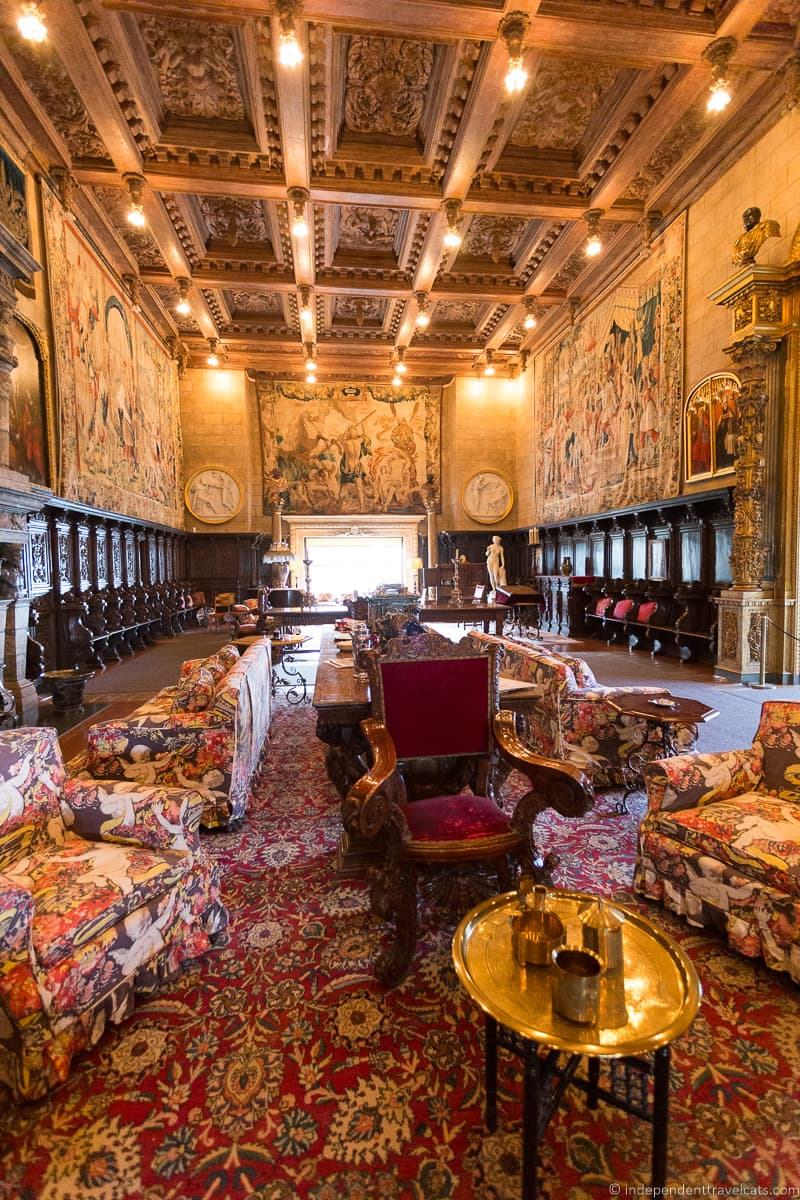
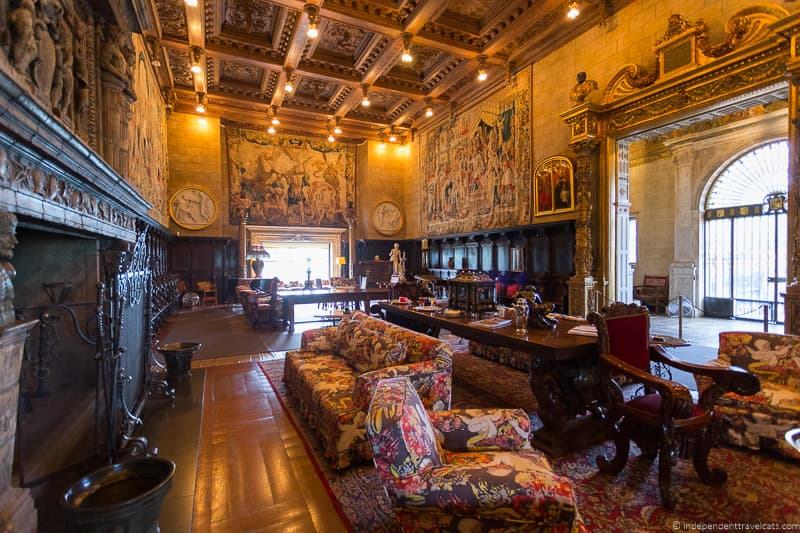
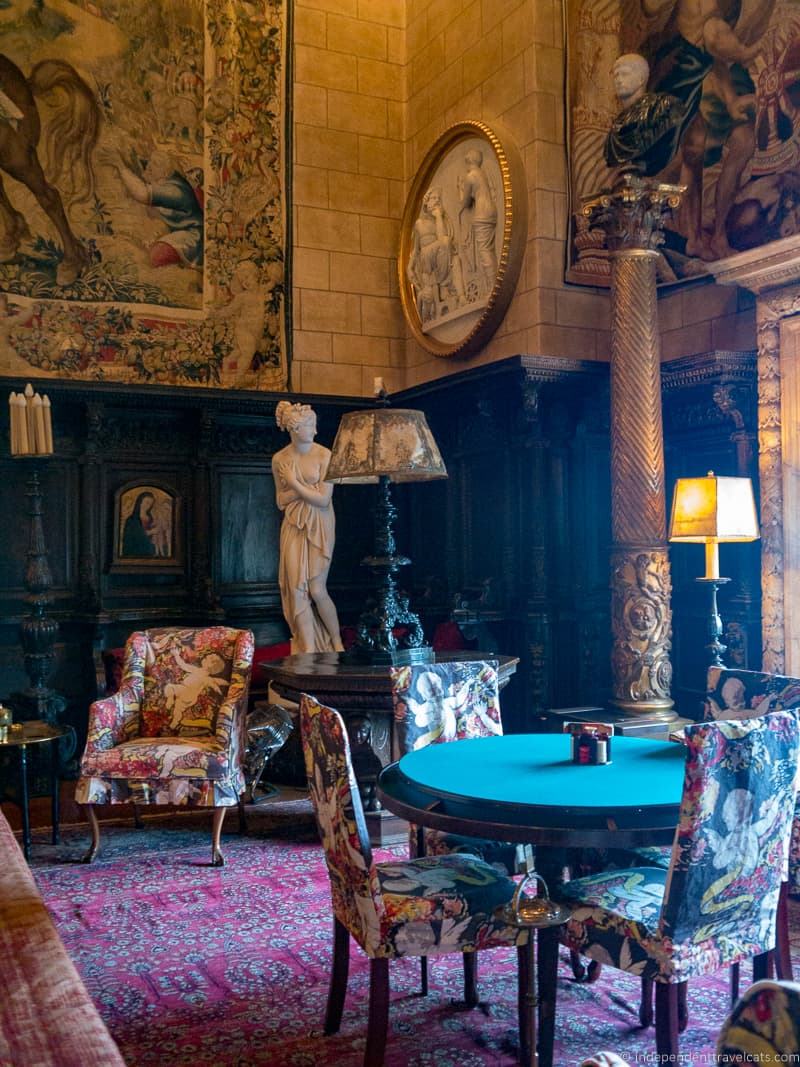
The Assembly Room is the largest and grandest of the public rooms, and it was here that Hearst and his mistress (or wife) would often greet their guests. It was also used for evening cocktails, conversation, and reading.
The room contains beautiful walnut paneling, a ceiling from an Italian palazzo, a fireplace from a French chateau, a set of four tapestries believed to be designed by Giulio Romano, large marble medallions, a painting of the Annunciation by Spanish painter Bartolomé Pérez de la Dehesa, and a number of neoclassical sculptures. Among these is the Venus Italica by Antonio Canova, one of Hearst Castle’s most treasured pieces.
There is also a sentimental Victorian-era piece in the room that may look a bit out of place: the Orchid Vase lamp. The base is a vase created in 1889 by Tiffany & Co. that won honors at the 1889 Paris Universal Exposition. Hearst’s mother Phoebe purchased it and had it converted into a lamp, and later William Hearst kept it here as a tribute to his mother.
The room is a bit overwhelming to try to take in all the art, furniture, and decorations, and the guide helps direct you to the most important pieces. The Assembly Room also holds secrets, such as a hidden door that allowed William Randolph Hearst to come and go as he pleased with little notice.
The Refectory (The Dining Room)
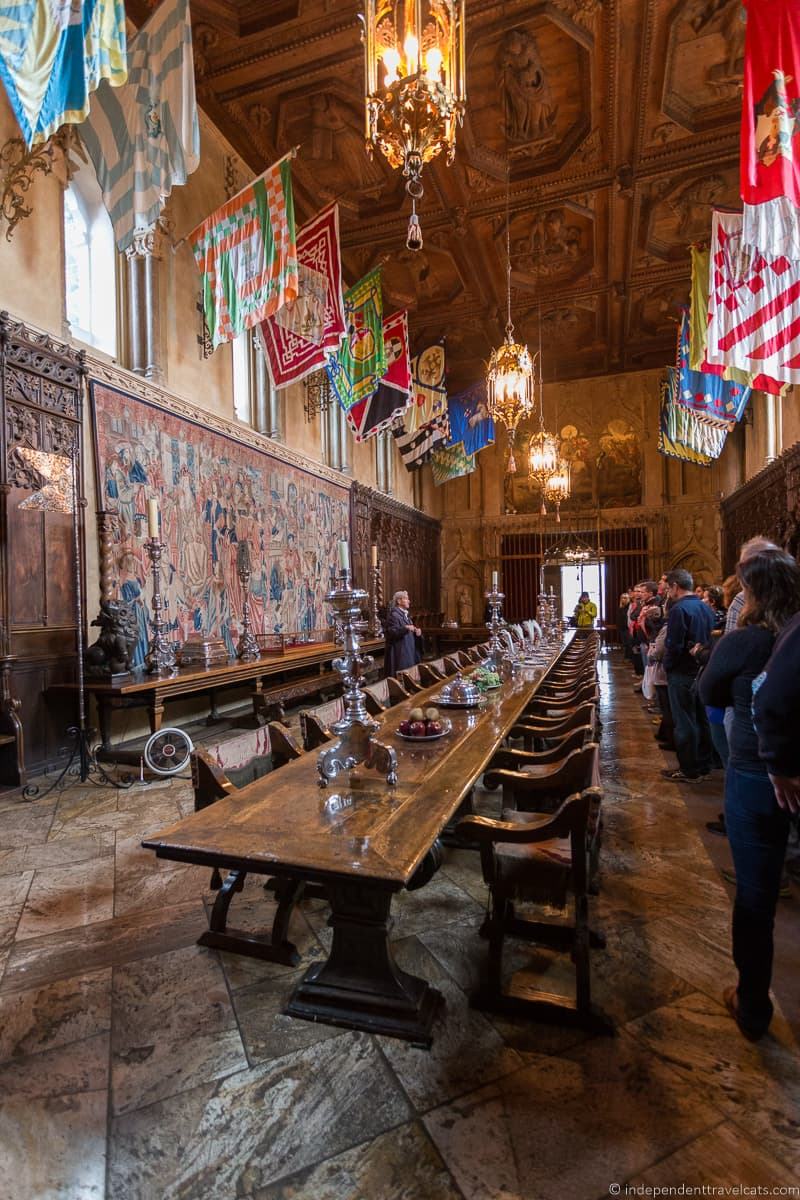
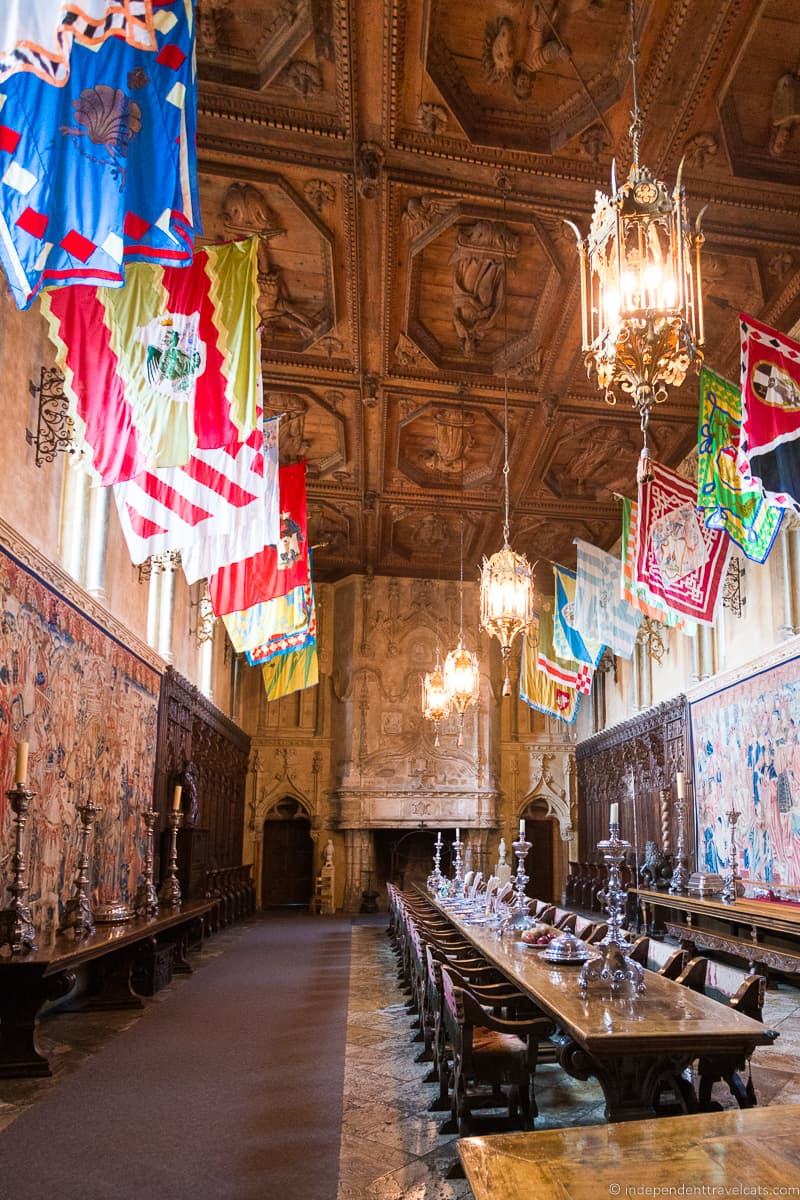
Next you head into what resembles a Gothic dining hall from the Middle Ages. This is what Hearst and Morgan intended, and it was referred to as The Refectory, the term used for a dining hall in a monastery.
The room is lined with wooden choir stalls and is framed by colorful silk banners from Italy. It has high windows and a carved Italian Renaissance ceiling. The long table in the middle, from an Italian monastery, is set with lots of fine silver candle holders and silverware.
The opulent silver collection stands in contrast to the paper napkins and bottles of mustard and ketchup Hearst often had at the table. These were the simple, nostalgic touches Hearst liked in order to keep things a bit more informal at his ranch.
Overlooking the Refectory is a minstrel’s gallery, or Musician’s Loft as it was called by Hearst and Morgan. Music would be piped in here during dinner. On rare occasions, it was used for live music performances; Roy Rogers and the Sons of the Pioneers played here at least once.
P.G. Wodehouse wrote the following to his friend William Townend about his experience dining at Hearst Castle in February 1931:
“Meals are in an enormous room, and are served at a long table, with Hearst sitting in the middle on one side and Marion Davies in the middle on the other. The longer you are there, the further you get from the middle. I sat on Marion’s right the first night, then found myself being edged further and further away till I got to the extreme end, when I thought it time to leave. Another day, and I should have been feeding on the floor.”
Although Hearst and Marion Davies clearly knew how to show their guests a good time, guests were expected not to wear out their welcome.
The Billiard Room
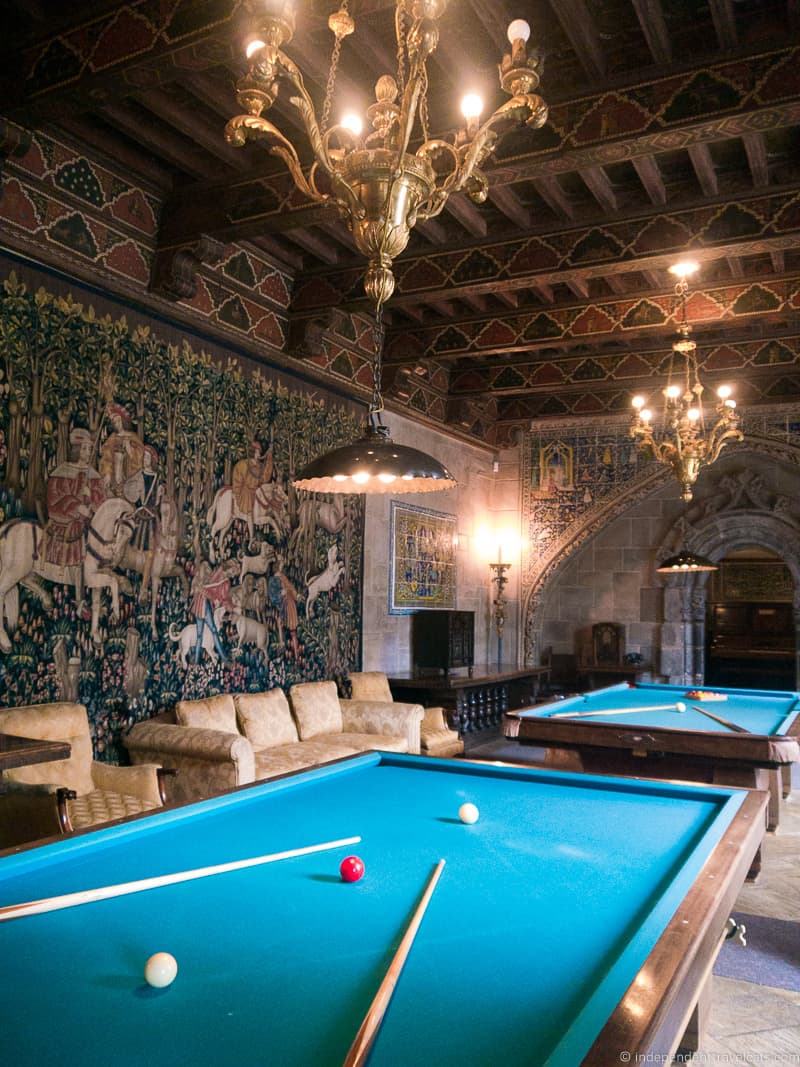
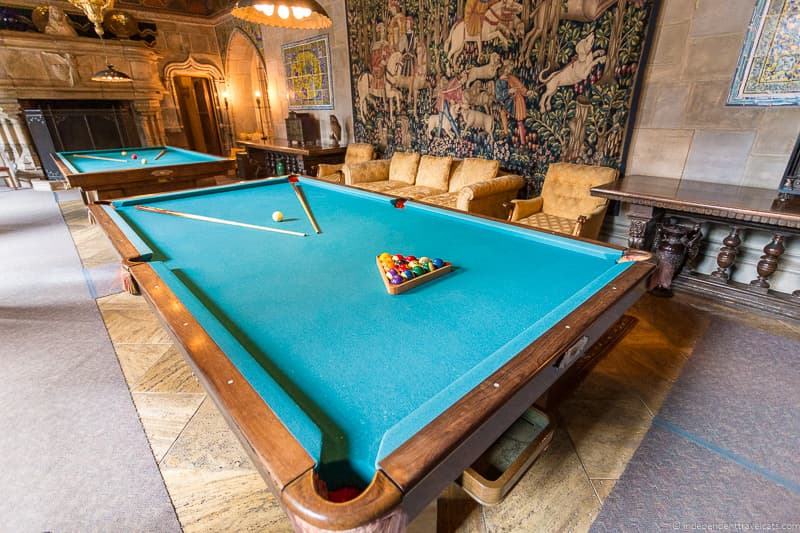
The Billiard Room, originally a breakfast room, was a popular spot for guests. Here they could enjoy games of billiards and pool, and there was also a small sitting area where they could relax and read.
Some notable features are the 15th-century painted Spanish ceiling, the French fireplace, the 15th-century Flemish woven wall hanging depicting a hunting scene, and the frieze over the door decorated with 16th-century Persian tiles.
The Theater
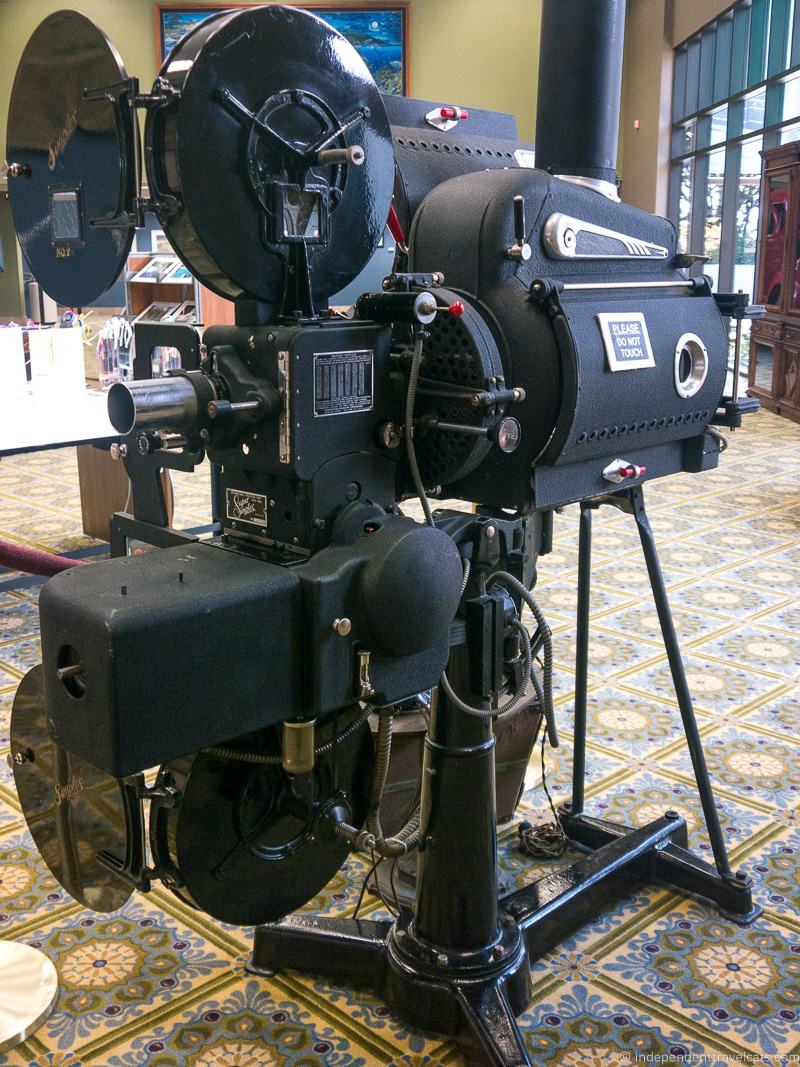
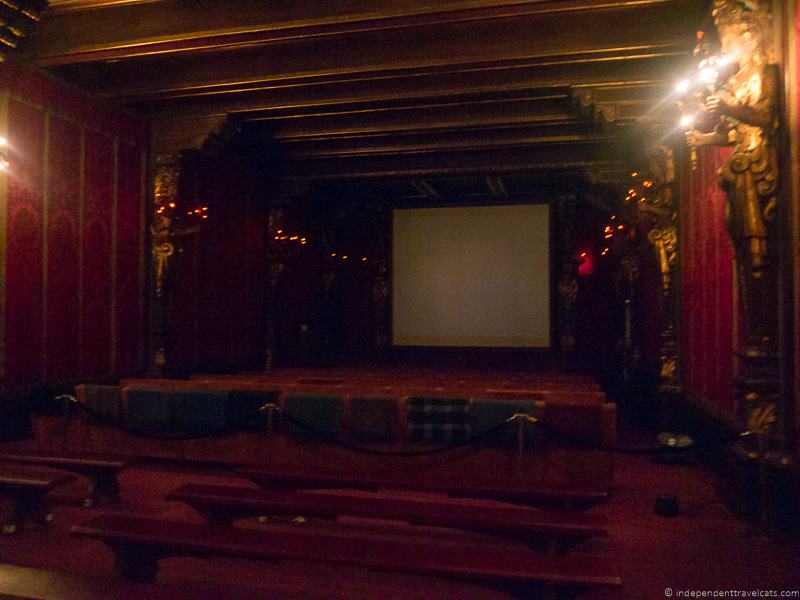
Next, we were led into Hearst’s private theater. Initially, films were shown outdoors to guests, but soon Hearst had his own indoor theater built. The theater was built to hold 50 guests and was used to both show films and host amateur theatricals put on by the guests.
Hearst would show a full-length film and newsreel almost every night at Hearst Castle. A driver would often bring a new film each day from Los Angeles for the enjoyment of the guests. Later, this practice would spread, and hosting film screenings at private homes became very popular in Hollywood.
Not surprisingly, many of the films shown at Hearst Castle starred Marion Davies and were produced by Hearst’s own Cosmopolitan Studios. But he also often chose movies that starred or were directed by one of the many guests at the castle.
In 2015, the film Citizen Kane was shown in the theater at Hearst Castle for the first time, with permission from the Hearst family. The proceeds benefited the San Luis Obispo International Film Festival and the Friends of Hearst Castle preservation group.
We were shown a short film with clips of Hearst and his guests spending time at Hearst Castle in the early 20th century. This was a good way to end the inside part of the tour.
The Hearst Castle Pools
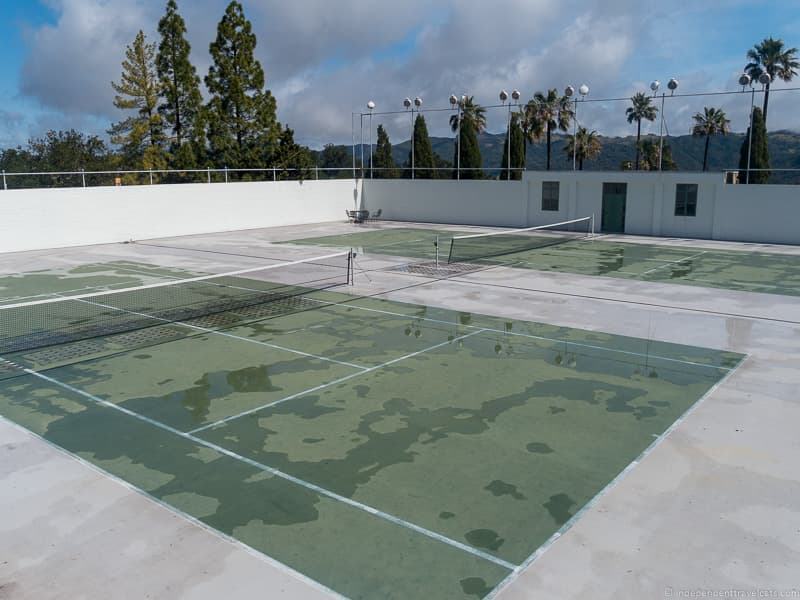
Next we headed out of Casa Grande to see the swimming pools and take a peek at the tennis court. Hearst had both an indoor and an outdoor swimming pool built on the property, both on a gigantic scale.
Interestingly, the staff actually gets to swim in and enjoy the pools once or twice a year, what a pool party! Members of the Hearst family also occasionally use the house, and Lydia Hearst held her bachelorette party at Hearst Castle in 2016, which included time in the Roman Pool.
The guided tours visit the pools and give you a good overview of both, but as with the gardens, you can revisit them after your tour ends if you want to spend more time looking or taking photos.
Neptune Pool
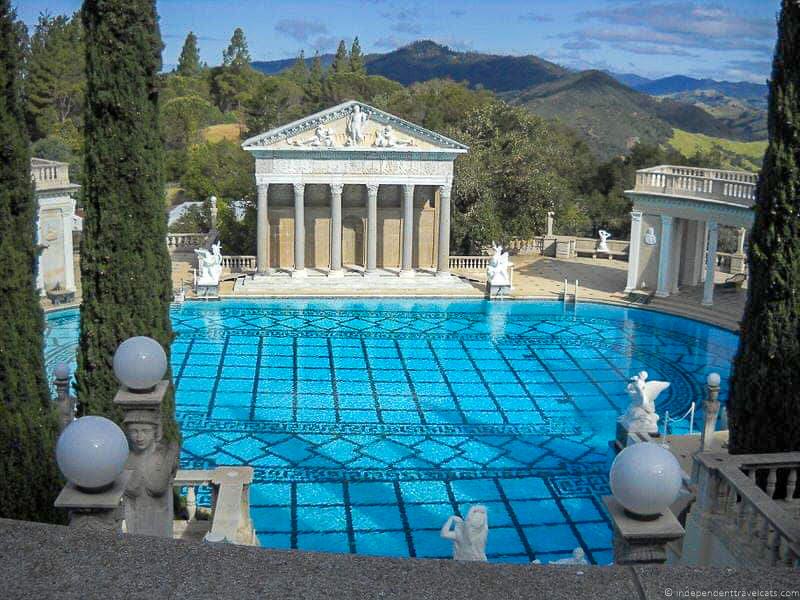
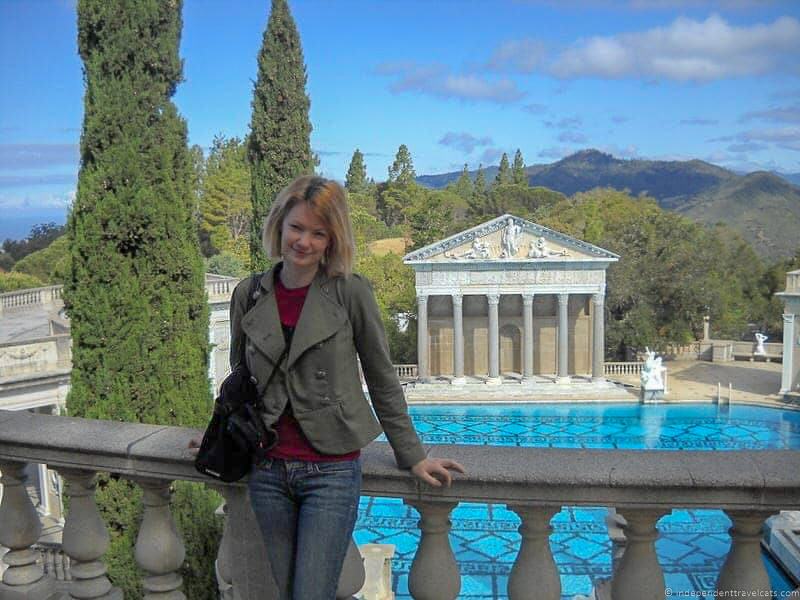
The Neptune Pool is probably one of the best-known outdoor features at Hearst Castle. It was the very first pool built at La Cuesta Encantada and it sits along the edge of the hilltop. The first pool was built because Hearst’s wife and kids wanted somewhere to swim.
Although the first pool here was completed in 1924, Hearst kept wanting to expand it to incorporate statues and antiquities he wanted to display as part of the pool complex. It would be enlarged twice more and reached its current size in 1936.
Today the pool is 104 feet long and holds up to 345,000 gallons of water. There are also showers and dressing rooms here.
The Neptune Pool is lined with marble tiles from Vermont and is decorated with a number of statues, many made by French sculptor Charles Cassou. In the center is a Roman temple, partly an actual original Roman temple and partly constructed of other elements Hearst purchased in Europe.
The pool was drained and underwent a massive $10 million restoration in 2014 after major cracks and leaks were discovered. It was re-opened and refilled in the summer of 2018, and it remains filled and on the tour routes today.
Roman Pool
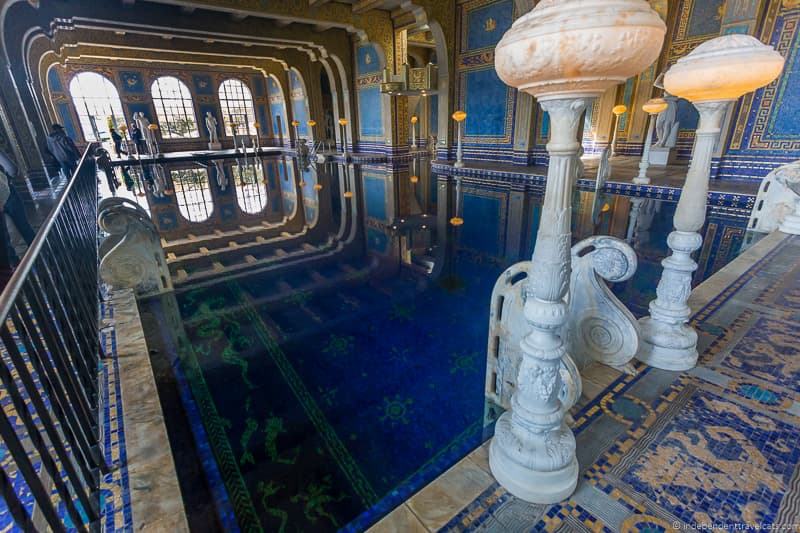
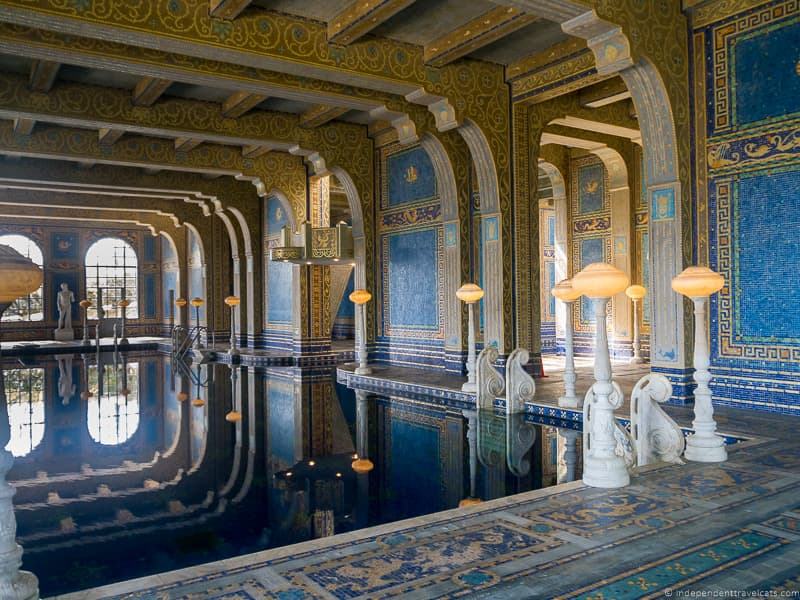
The Roman Pool at Hearst Castle is a heated indoor pool decorated with beautiful tiles and eight marble statues. The pool was built between 1927 and 1934 and is designed to look like an ancient Roman bath such as the Baths of Caracalla. It is located behind Casa Grande.
The Roman Pool is decorated from top to bottom with 1-inch square mosaic tiles made of Murano glass. The tiles were designed by Camille Solon and were inspired by the 5th-century Mausoleum of Galla Placidia in Ravenna. Most are blue, orange, or gold. The ceiling is particularly beautiful with its night-blue tiles and stars.
The eight marble statues around the Roman Pool were created from Carrara marble by Italian sculptor Carlo Freter. They are all based on ancient Greek and Roman statues of gods, goddesses, and heroes.
The Roman Pool is 1,665 square feet and can hold 205,000 gallons of water. It is up to 10 feet deep. There are also dressing rooms here, and behind the pool are the tennis courts.
This is the most beautiful indoor pool we’ve ever seen.
Eating at the Visitor Center
After visiting both pools, we were able to wander around the gardens as long as we wanted. The buses back down the hill leave about every 15 minutes, and you just need to make sure you catch one before the last one of the day.
After the bus ride back down to the Visitor Center, we grabbed some food at the cafeteria-style dining area called Chief’s Galley Cafe. I’ve eaten here twice.
The food is a bit overpriced, as you’d expect, and the first time it was pretty mediocre and unmemorable. The second time we tried the hamburgers made with local Hearst Ranch beef, and these were pretty good. Still a bit overpriced though.
We also checked out the gift shop and found they had a good selection of books. If you’re interested in learning more about Hearst or Hearst Castle after your visit, some great books and videos are for sale here.

Overall Thoughts on Visiting Hearst Castle
Overall, we really enjoyed the tour, the scenery, and walking around the gardens. The film was interesting and our guides on both visits were very professional and knowledgeable. The food was OK but overpriced, and that was really the only downside to our visit.
Some of the highlights for us were the gardens, which were very pretty in Spring, the two swimming pools (the outdoor Neptune Pool and indoor Roman Pool), the Assembly and Refectory rooms of Casa Grande, and being able to watch some short film clips in the private theater.
Although the architecture and design may not be to everyone’s tastes, it is amazing what Julia Morgan and Hearst were able to create together. The art and decorative elements in the buildings are remarkable. It can be a bit overwhelming to take it all in, so it was great to have the chance to visit more than once.
The Grand Rooms Tour is a great introduction to the house. We’d love to visit again to see the Upstairs Suites and other areas on a future visit. I’ve always wanted to do one of the seasonal evening tours, with a longer guided walk at night and docents dressed in 1930s clothing enacting life as it would have been during the time.
California State Parks seems to be doing a very good job maintaining the property and offering professional tours to the public. There are very few places like this in the United States, and we think it’s worth seeing at least once.
Tips for Making the Most of Your Visit to Hearst Castle
After two visits, here is what we’ve learned about getting the most out of a day at Hearst Castle.
- Book your tour tickets in advance if you can, especially during the busy summer months and holidays when tours can sell out.
- Arrive at the Visitor Center at least 15 to 20 minutes before your tour so you have time to collect your tickets and wristbands and make it onto the bus.
- Watch the film at the Visitor Center before your tour if you have time, as it gives helpful background. If you can’t fit it in beforehand, watch it afterwards.
- Baby strollers, luggage, chewing gum, food, and tripods are not allowed on the tours, so leave these in your car.
- The temperature can be hotter or colder on the hilltop than at the Visitor Center, so dress in layers. Bring a hat and sunscreen on sunny days, as you’ll spend time outside during the tour.
- No food or drinks are sold on the hilltop, so plan meals and snacks accordingly. Bottled water is fine to bring on the tour, but no other drinks, food, or gum is permitted. We’d bring a reusable water bottle, especially in summer.
- There are restrooms at the Visitor Center, and toilets on the hilltop if you need them, though it’s best to use the Visitor Center ones before or after your tour. During droughts, portable and chemical toilets are sometimes used to conserve water.
- If you have difficulty with stairs, note that the regular tours include anywhere from around 150 to over 300 steps and a fair amount of walking and standing. Consider one of the stair-free ADA accessible tours instead.
- The tours are not always well-suited to young children. They are guided and timed, and children need supervision to avoid touching the art and furniture, most of which is not roped off. The length (70 to 75 minutes) can be hard for little ones, so think about whether it’s a good fit. Strollers are not allowed.
- If you have flexibility, try to visit in good weather so you can better appreciate the gardens and the views over the undeveloped land and ocean.
- If you book two tours in the same day, you’ll usually need to take the bus down the hill between them, so leave at least two hours between start times and ask where to meet when you collect your tickets.
- For more things to do in the area, see our guide to things to do in Cambria and San Simeon to plan a full day of sightseeing.
That’s our guide to visiting Hearst Castle in San Simeon. We hope it helps you plan your own trip to this special American castle on the Central Coast of California.
Planning a trip to Hearst Castle? You may want to PIN this article to Pinterest to read later:
So what do you think, is Hearst Castle worth a visit? Have you been? We’d love to hear your thoughts and any tips you have for those planning a visit. Just let us know in the comments below.
As always, feel free to ask us any questions you have about visiting Hearst Castle or things to do in Central California.
cathleen R corell Post author
Hearst castle has been shut downsince march 2020. There is no date to reopen..
Jessica & Laurence Norah Post author
Hi Cathleen,
Yes, Hearst Castle is currently closed due to road repairs (damage caused by a bad storm in Jaunary 2021) and the work began in July 2021 which is expected to take 6 to 9 months according to their website. Hearst Castle is expected to reopen in Spring or Summer 2022 to visitors, but as you note no date has been set.
We will make this clearer in our article and post this information at the top in red so this is more obvious to readers. Thanks for pointing this out.
If you haven’t had a chance to visit yet, I hope you get to do so once it reopens!
Best,
Jessica
Jessica & Laurence Norah Post author
Hearst Castle reopened to the public on May 11, 2022. So it is now open to visits and most of the tours and facilties are exactly as they were two years before its closures due to road repairs and COVID-19.
Melody Svennungsen Post author
Instead of gifts, we try to give each of our 5 grandchildren an “experience” for their birthdays. Since we live near San Simeon, the 9th year is a trip to Hearst Castle .. .. .. 4 down and one kid to go, we will take him up the enchanted hill next week. As we were leaving the castle a couple years ago, we were looking out at the gorgeous ocean view when our “princess” g-daughter sighed dramatically and said, “Oh, I just wish I could live here.”
travelcats Post author
Hi Melody, I think that is a great idea to do something experiential for your grandchildren. I think kids especially remember the trips to the park, zoo, castles, theme park, beach, etc. with their family when they grow up and look back on their childhood rather than toys or clothes. Thanks for taking the time to comment and I am sure your granddaughter will love the trip to Hearst Castle! San Simeon and Cambria are situated in a beautiful part of the world. ~ Jessica
Lorraine BertoniIl Post author
I am planning a vIsit to Hearst Castle in August 2015 with my daughter. I would love your advise as to how many different tours we should book in one day. Is one sufficient or should we pick two? If you suggest two, then which ones should they be? Thank you for any help and planning ideas.
travelcats Post author
Hi Lorraine,
I love Hearst Castle and I have visited twice. On the first trip in 2013 I did a tour called “The Experiences tour” (no longer one of the options) and the second time we did the tour called “The Grand Rooms”. For first time visitors, “The Grand Rooms” is the recommended tour by the castle staff and I would agree as it covers the grandest and most opulent rooms. On my first visit, I also got to tour through a couple of the “cottages” but these are not nearly as well-decorated or grand as the rooms in the Casa Grande. If I were to choose a second tour, I’d probably recommend the upstairs tour as it includes the opulent library, bedrooms, and views from the top floor which are not included on “The Grand Rooms” tour. The evening tours sounds wonderful, but it won’t be running during your visit. Honestly though I think if you don’t want to spend the money for a second tour, “The Grand Rooms” are probably a highlight for most visitors, along with the beautiful gardens and pools which are included in all tours. After each tour, you can explore the gardens, outdoor art, and two pools at your leisure so I would definitely make time for this and there are great views from the top of the hill. Before or after your tour, also make room for the free 40-minute film in the Visitor’s Center (just keep your ticket) as it is excellent and definitely adds something to the experience. August is a busy time and I would recommend booking your tickets ahead as some times slot often sell out in advance during high season. I hope you and your daughter enjoy your visit! ~Jessica
Megan C. Stroup Post author
I think the tour you took is now called the “Grand Rooms” – that was also the tour I did on my first trip there. You look like you had gorgeous weather; unfortunately, both times I went it was rainy and cloudy (typical for that area of the coast), but I will probably go back again one day to do the cottages tour, and hopefully it is sunny then! 🙂
travelcats Post author
Yes, it seems that they keep changing up the tour names and what is included in each one. Yes, the weather was great during our visit, it is definitely more pleasant to take in the gardens and outdoor views when the weather is clear and nice. But the inside is wonderful regardless and glad you’ve enjoyed your tours so much. We’d like to return and do one of the evening tours at some point.
Dana Post author
We saw zebras grazing as we drove past the property on our way down the coast – unbelievable! We didn’t stop with the kids though – too pricey for an attraction they weren’t interested in. So I loved seeing your photos, and hope one day my husband and I can go back and take the tour.
travelcats Post author
Dana, wow, that is wonderful that you got to see the zebras! I would definitely recommend going back at some point for a tour of Hearst Castle. It really is a well-done and organized tour, although better for older kids and adults. Go in nice weather so you can spend extra time wandering around on your own outside, the gardens are really pretty in the Spring and Summer.
David Post author
Nothing against Hearst castle, but I’m glad you mentioned the elephant seal rookery. It is so cool, very much worth a visit, and not nearly as well known as the castle.
travelcats Post author
Indeed, interesting and free:) I think the whole rocky, undeveloped coastline in this area is just wonderful.
Melissa Post author
This article saddens me, but only because it points to what I missed while I lived in San Francisco. The pictures and the descriptive details whisks me into a 20th century fantasy – if only the Hearst Castle walls could talk! The Roman pool is amazing and wow, I would love to be among the staff for one of those pool parties! Next time I’m in California, I’m going to visit Hearst Castle and put your tips to work! Now, I need to re-watch Citizen Kane…
Thanks for the great article!
travelcats Post author
Melissa, I hope you get the opportunity to visit Hearst Castle some day. Although in France, there are so many castles you can visit until then!
Amy Post author
I so enjoyed visiting Hearst Castle! It is in such a gorgeous location as well. We visited during elephant seal season so it was fun to see those mammoth creatures before wandering the grounds of Hearst. I definitely need to see Citizen Kane now, too 🙂
travelcats Post author
Yes, I love the rugged coastline in this area and elephant seals are always a great plus:) I wasn’t a huge fan of Citizen Kane when I watched it as a teen, but learning the history of William Randolph Hearst actually made me appreciate it more.
Peter Romwall Post author
I am a guide at Hearst Castle and enjoyed the description of your visit. I would like to add that Hearst Castle is an accredited art museum and there is some evidence that William Randolph Hearst was intending it to be an art museum. In the 1920’s he wrote to the architect Julia Morgan, “I see no reason why the ranch should not become a museum of the finest things I can obtain.” He told his son, William Randolph Hearst Jr., “We are only borrowing this house until I can make a gift of it to the people of America.” In that sense, it is not different than any other museum in the country that features European art, including The Metropolitan Museum of Art, stocked with European art and architectural features bought and donated by wealthy Americans including J.P. Morgan.
travelcats Post author
Thanks so much Peter for stopping by our blog! Thanks for the additional info on the history and Heart Castle’s status as an art museum. Ethan and I would love to return for one of the night tours some day. Do you have any additional tips for readers thinking about visiting?
Peter Romwall Post author
Your description and suggestions are really everything that one needs to know to enjoy a visit. The one thing that I might suggest is for visitors to pursue a particular interest. The art is just one part of the story. William Randolph Hearst was probably the most talked about private citizen in the first half of the 20th century and probably the most well-know American in the world after Franklin Roosevelt, and for many, many reasons besides his house at San Simeon. The architect Julia Morgan, the most prolific architect in U.S. history has a fascinating story and is worthy of investigation. The story of the construction of the Castle is mind-boggling for those interested in that aspect. There are many other avenues to pursue. After the 40 minute guided tour, guests have the opportunity to explore all the gardens and terraces at their leisure until the park closes. Climb the outside balconies on Casa del Monte and Casa del Mar and peek into windows. The best view on the hilltop is from the balcony on Casa del Mar which is why Mr. Hearst used that house from 1945 to 1947. His bedroom is the on the south-east corner. The opposite balcony was the bedroom of his companion, Marion Davies. Highly trained, experienced and knowledgeable guides are stationed throughout the park and we are NOT there to be policemen or security guards. We are there to answer your questions and speak with you about any topic or point of interest. A small amount of research before one visits and the willingness to ask questions and interactively participate in the experience can highly enrich one’s visit. And by all means, plop down on a chaise lounge by the Neptune Pool, put your feet up and pretend like you own the place!
travelcats Post author
Wow, thank you so much for your detailed and thoughtful response! I appreciate the insider’s scoop on how to make the most of a visit to this fascinating place. We’ll have to plan a return visit soon!
Rachel Post author
Wow. My husband is from California but we have never made it to the “Hearst Castle”. I’ll be adding it to my list after seeing this. Thanks!
travelcats Post author
Thanks for stopping by Rachel! Yes, it’s a bit out of the way but a fun trip. We did it in conjunction to a visit to some along cities along the Central Coast.
Meredith Post author
It’s hard to believe that so much world history is assembled in a (once) private home in CA instead of a museum! I’d say the family certainly had eclectic taste 🙂 I’ve heard quite a bit about Hearst Castle (and seen Citizen Kane a few times) and would love to go. Thanks for the run through and the travel tips – no doubt they’ll come in handy!
travelcats Post author
Yes, you should definitely head here if you are in California! I should re-watch Citizen Kane as it has been a long time since I saw it.
Louisa Post author
That is crazy, in an amazing way! A mish-mash of styles and historical eras and artifacts that could only work in this place.
travelcats Post author
Yes, it is certainly both an odd and fascinating place!